

Background
A 76-year-old man came to Indimasi for Ayurvedic management of Parkinson’s disease, which he had lived with for four and a half years, alongside dementia that had developed over the preceding two and a half years. He also carried a right renal artery stent, placing him in a category of patient we treat with particular caution elderly, neurologically complex, and cardiovascularly compromised.
His day-to-day Parkinson’s and dementia symptoms were extensive and interconnected: constipation, bloating and flatulence after meals, fluctuating blood pressure, persistent drooling, tremor in both hands, a markedly reduced attention span, and a heaviness in both legs that left them feeling “lifeless” after he’d been sitting for any length of time. For his family, the drooling and the visible tremor were the most distressing day-to-day signs; the dementia showed up more in his withdrawal from activities like reading, which he’d once done daily.
Given his age, the duration of both neurological conditions, and his cardiac history, this case called for a treatment goal that was realistic rather than curative: support function, comfort, digestion, and cognitive engagement within the bounds of two progressive conditions, not treat Parkinson’s disease or dementia as reversible.
The Ayurvedic Perspective: Kampavata and Cognitive Decline
In Ayurveda, the tremor, rigidity, and movement difficulty seen in Parkinson’s disease are described under Kampavata a condition of aggravated Vata dosha affecting the nervous system and musculoskeletal control. Dementia-type cognitive decline is understood as a depletion of Majja Dhatu (nerve and marrow tissue), compounded by Vata derangement affecting Prana Vata, the sub-dosha governing brain function, attention, and sensory processing.
What made this case distinct on assessment was that he was also showing clear Ama lakshanas signs of undigested metabolic byproduct (Ama) in the system, consistent with his constipation, bloating, and flatulence. This is an important clinical distinction in Ayurvedic treatment for neurological disorders in elderly patients: a frail, tremor-affected patient with visible muscle wasting often looks like a textbook candidate for immediate Brimhana (nourishing, tissue-building) therapy. But when Ama is present, nourishing the tissues before clearing that toxic load can backfire, feeding the Ama rather than the patient. This shaped our entire sequencing of care.
The Integrated Treatment Approach
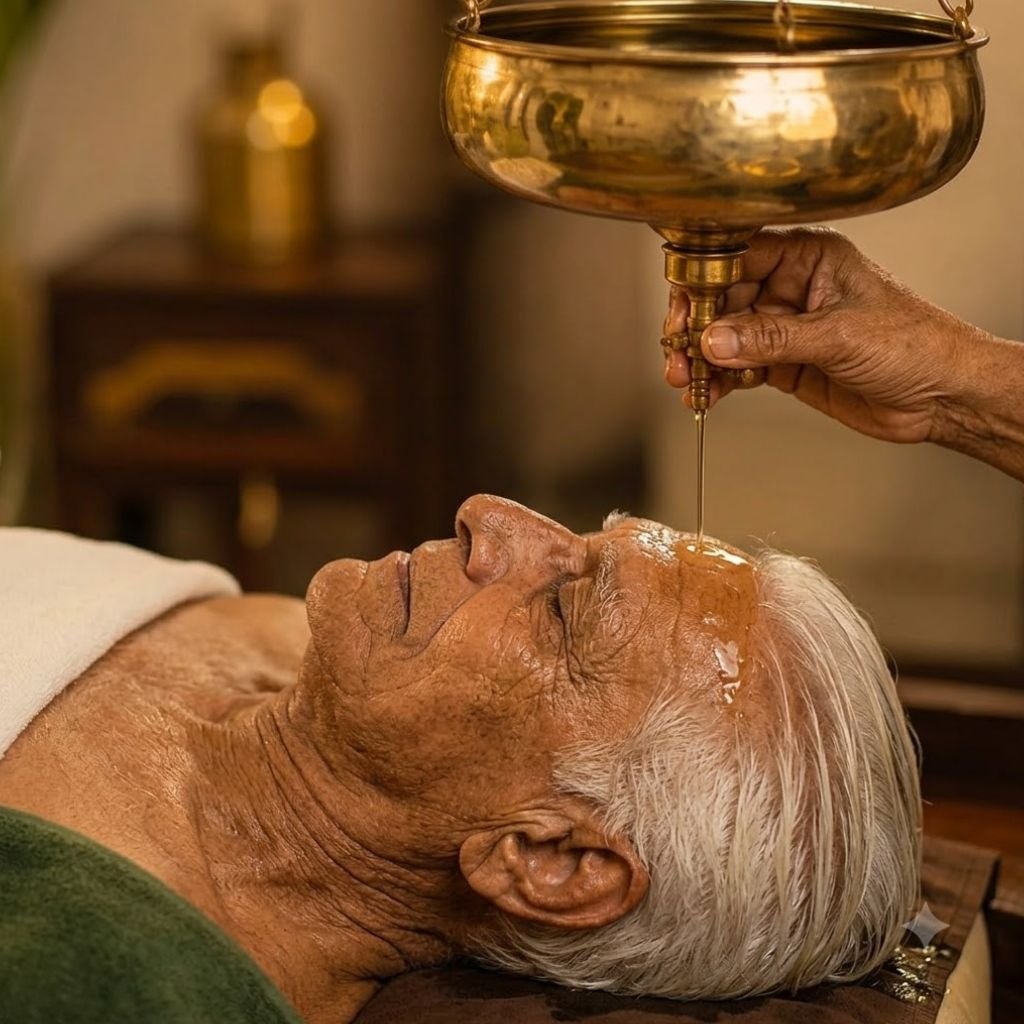
Rather than treating his tremor, drooling, digestive symptoms, and cognitive decline as separate problems, we built a 28-day program combining five elements: internal Ayurvedic medicines (Deepana and Pachana formulations to rekindle digestive fire and clear Ama, used as the foundation before any nourishing treatment); external neurological therapies (Abhyangam, Kashaya Dhara, and Ksheera Dhooma, aimed at the tremor, limb heaviness, and neuromuscular symptoms directly); Shirodhara, introduced later specifically to support nervous system function and cognitive engagement; a personalized Vata-pacifying, anti-inflammatory diet supporting digestion without adding to his existing Ama load; and daily movement and breath practice pranayama taught personally by Guru Yogi Shivan (Guruji), alongside Kalari and yoga adapted to his physical capacity addressing the mind-body dimension of a condition that affects confidence and engagement as much as physical function.
This was part of a Personalized Ayurveda approach, with the treatment sequence adjusted according to his condition and, importantly, how he responded to each therapy. As an ayurvedic treatment centre in Kerala, Indimasi focuses on individualized care for complex conditions while taking each patient’s overall health and existing medical history into consideration.
The 28-Day Program
Days 1–3
Treatment began with Deepana-Pachana medicines to address the Ama lakshanas, alongside Abhyangam to begin improving circulation to his limbs. Within three days, his drooling one of the most visible and distressing symptoms for his family stopped completely and did not return for the remainder of his stay.
Early Weeks — The Brimhana Test
At one point, we introduced more nourishing (Brimhana) therapies, on the reasoning that a frail, elderly patient with visible tissue wasting would benefit from tissue-building support. Instead, he became noticeably drowsier. We read this as a clear sign that his system hadn’t yet cleared enough Ama to make use of nourishment, and returned to the Ama-Pachana line of treatment rather than pushing ahead with a therapy that wasn’t landing well. This kind of real-time adjustment built around how the individual patient actually responds, rather than a fixed treatment template is central to how Panchakarma-based Ayurvedic treatment works for complex geriatric and neurological cases.
Weeks 1–3
As the Ama-Pachana treatment continued alongside Kashaya Dhara and Ksheera Dhooma, his physical strength improved considerably. His gait became steadier, he handled exercise with more ease, and he regained the ability to get up off the floor unassisted a marker of functional independence that had been compromised by his Parkinson’s-related rigidity and weakness.
Week 4 Onward
Once his system had cleared enough Ama, we introduced Shirodhara. Shortly after starting it, he began reading the newspaper again something he hadn’t done regularly since the dementia progressed. This was a meaningful marker of improved attention span and cognitive engagement, and one that mattered as much to his family as any of the physical changes.
Throughout all 28 days, he practiced pranayama taught to him directly by Guru Yogi Shivan, and took part in daily Kalari and yoga adapted around his mobility.
Diet
He followed an anti-inflammatory, Vata-pacifying diet for the full duration of his stay chosen to calm the aggravated Vata dosha driving his tremor, limb heaviness, and neurological symptoms, and to support digestive fire without adding further Ama. As with the internal medicines, the diet was treated as part of the same sequencing logic: settle digestion first, then support strength and nourishment.
Guruji’s Intervention
Guruji’s sessions with him focused primarily on providing emotional support, instilling hope, and helping him regain confidence in his ability to overcome the limitations imposed by his condition. At the beginning of his stay, he was deeply discouraged and had lost faith in the possibility of improvement. Through daily counselling, Guruji gradually helped restore that sense of hope, offering consistent mental encouragement and teaching him guided breathing techniques. As he began experiencing positive changes, his confidence grew, motivating him to continue these practices with commitment. By the end of his stay, he was smiling more often and had resumed activities such as reading the newspaper — something he had been unable to do since the onset of his illness.
The Outcome
- Neurological symptoms: Drooling stopped completely within 3 days and did not recur through discharge. Hand tremor and the sensation of leg heaviness eased as the program progressed.
- Physical strength and mobility: Substantial improvement in gait, exercise tolerance, and the ability to rise from the floor unaided — a functional gain directly relevant to his daily independence and fall risk.
- Cognitive function and attention: Noticeable improvement in attention span following the introduction of Shirodhara in week 4, most visibly marked by his return to independently reading the newspaper.
- Digestion: Constipation, bloating, and flatulence eased in step with the Ama-Pachana treatment, supporting the broader recovery rather than remaining a standalone complaint.
Overall, his Parkinson’s and dementia symptoms showed meaningful functional improvement during the 28-day supervised program, particularly in drooling, gait, strength, attention, and cognitive engagement.
Why This Worked
The clinical turning point in this case was sequencing, not any single therapy. Recognizing the Ama lakshanas and holding Brimhana back until his system was ready for it — confirmed by his drowsiness when we tested nourishing therapy too early — meant every treatment that followed had a better chance of actually being absorbed and used, rather than compounding an existing toxic load. Once that groundwork was laid, Abhyangam, Kashaya Dhara, and Ksheera Dhooma addressed the physical, neuromuscular side of his Parkinson’s symptoms; Shirodhara supported the cognitive and nervous system side associated with his dementia; the Vata-pacifying diet kept digestion aligned with the internal medicines; and the daily pranayama, Kalari, and yoga — including direct guidance from Guru Yogi Shivan — gave him a consistent, structured way to rebuild physical confidence and mental engagement side by side. For a geriatric patient managing two progressive neurological conditions and a cardiac history at once, treating these dimensions together, in the right order, made a difference that isolated symptom management likely would not have.
The foundation was the focused and determined mindset he cultivated throughout the healing process. We believe that none of these interventions would have achieved the same outcome without his commitment and mental resilience. Through Guruji’s counselling sessions, based on the “Mind as Medicine” approach, he developed the confidence to move beyond the long-held belief that his condition was incurable. He also practiced the breathing techniques taught by Guruji consistently and without fail, reinforcing this positive mindset and complementing the physical aspects of the treatment program.
What This Means for You
For families navigating Parkinson’s or dementia in an elderly relative, this case suggests that digestive health, sequencing of therapies, and daily structured movement and breath practice can meaningfully support specific symptoms and day-to-day function — alongside, not instead of, ongoing neurological and cardiac care. It is not a suggestion that either condition can be reversed, and individual results vary considerably based on age, disease duration, and overall health.
For families exploring an ayurvedic treatment centre in Kerala, this case also highlights the importance of looking at the individual as a whole and adapting the treatment approach according to their physical condition, digestive health, neurological symptoms, and response to therapy.
Medical Disclaimer
This case study reflects one patient’s improvement in specific symptoms and daily function during a supervised 28-day inpatient program — not treatment, reversal, or resolution of the underlying conditions. Given his age and comorbidities, including the renal artery stent, he continued, or should continue, under the care of his neurologist and cardiologist, with this program positioned as complementary rather than a replacement for that care.
Curious whether an integrated program could support your family member’s day-to-day function?
CTA: Enquire with our medical team →