

Background
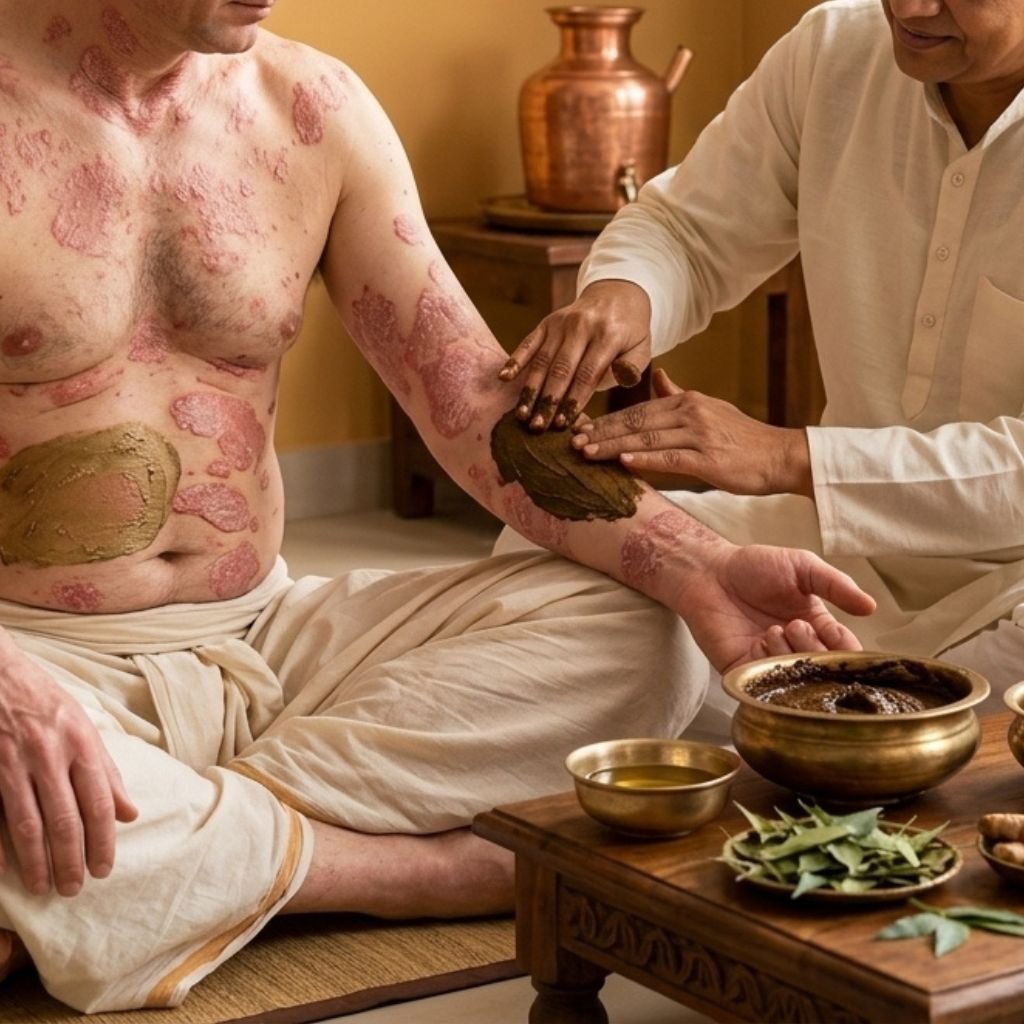
A 66-year-old male guest from Kerala came to Indimasi with moderate to severe plaque psoriasis that he had lived with for 40 years, affecting his upper limbs, lower limbs, buttocks, and back. His lesions followed a seasonal pattern, reliably worsening every December and January. Over four decades, he had tried allopathic medicine, traditional Ayurveda, homeopathy, and Siddha medicine, none had fully resolved the condition.
Seeking a more comprehensive approach, he visited Indimasi Healing Village, an Ayurvedic treatment centre in Kerala that focuses on integrated therapies addressing the body, mind, and lifestyle.
Alongside the visible skin symptoms, he was carrying significant mental stress and anxiety, and his appetite had declined. His diet and daily habits were otherwise sound, vegetarian, with regular digestion and good sleep, but four decades of living with a visible, itching, sometimes oozing condition had taken a toll that went well beyond the skin itself. He had, by his own account, come to accept it as a permanent part of life.
The Challenge
Forty years of managing a chronic condition tends to create a kind of normalized suffering, and that was true here. The predictable winter flare-ups meant he could anticipate the worsening each year without a way to prevent it. The itching and oozing contributed to ongoing stress and anxiety, and that stress, in turn, suppressed his appetite, reduced nutrition then made healing harder, reinforcing the cycle.
His previous treatments had offered temporary relief at various points but had not addressed what was sustaining the condition underneath the visible lesions.
The Treatment Approach: Pancha Bala Siddhantha
Rather than treating the skin in isolation, we built his 15-day program around Pancha Bala Siddhantha, an ancient Indian health philosophy framework built on five pillars that we believe need to move together for lasting change: Anna Bala (nutritional strength), Asana Bala (physical strength through movement), Prana Bala (strength through breath), Mano Bala (strength and power of mind), and Oushadha Bala (strength from medicine).
The reasoning was straightforward: a 40-year, seasonally triggered, stress-linked condition was not going to move through topical treatment for the skin alone.
This approach followed the principles of Personalised Ayurveda, where therapies, diet, and lifestyle practices are adapted according to an individual’s condition, constitution, and overall wellbeing.
The Treatment Plan
Nutrition (Anna Bala)
An anti-inflammatory Ayurvedic diet was built around his specific constitution, with additional internal treatment to restore appetite and support metabolism so his body could actually absorb and use what it needed to heal.
Movement (Asana Bala) and Breath (Prana Bala)
Daily yoga and Kalari supported circulation and reduced the physical tension that aggravates skin flare-ups. Pranayama worked directly on the stress and anxiety side of the picture, calming the nervous system patterns we believe were feeding his flare-ups, something conventional psoriasis treatment does not typically address directly.
Mental and Emotional Strength (Mano Bala)
Alongside yoga, daily meditation taught by Guruji targeted the anxiety that had built up over four decades, treated as part of the condition itself, not a side effect of it.
Medicinal Support (Oushadha Bala)
Ayurvedic herbal formulations supported appetite, metabolism, and natural elimination internally.
On the external side, Kashaya Dhara, a continuous pour of warm medicated herbal decoction over the affected skin, improved circulation to the lesions and supported the skin’s healing capacity. Lepam, a customized herbal paste applied directly to the lesions, worked to reduce itching and oozing and support tissue regeneration. Medicinal steam fomentation supported circulation and the skin’s natural detoxification.
Daily Kalari sessions, flowing martial arts movements, gentler than they sound, gave him circulation and physical strength benefits without the intensity that his condition and age required him to avoid.
The Journey
Days 1–4
Treatment began with fomentation, Kashaya Dhara, and Lepam applications, alongside internal medicines to rebuild appetite and metabolism. Daily Kalari and yoga sessions eased him into movement and began rebuilding his confidence in what his body could still do.
Days 5–15
By day five, improvement was clear, the itching that had been a near-constant presence for decades was noticeably reduced, and oozing from lesions had begun decreasing. As appetite normalized, energy followed.
Mental clarity improved alongside it, and the anxiety that had shadowed him for years began to lift — the combination of pranayama, Kalari, and physical improvement created a reinforcing effect between his mental and physical state.
Through the remainder of his stay, existing lesions continued healing, and no new lesions appeared during the admission — notable, given his 40-year history of ongoing new lesion formation. He described feeling more peaceful and relaxed than he had in years.
Guruji’s Intervention
Guruji provided optimistic counselling and reinforced this positive mindset through guided breathing exercises. He helped the patient shift a long-held belief that the condition was incurable, fostering a more hopeful and empowering perspective toward recovery.
The Outcome
- Skin: Existing lesions healed significantly over the 15 days; itching and oozing were markedly reduced; no new lesions appeared during the admission period.
- Appetite and digestion: Appetite returned to normal levels; bowel function remained regular throughout.
- Mental and emotional state: Stress and anxiety noticeably reduced; sleep remained sound; the patient described his own state as “feeling much better mentally.”
- Physical capacity: Energy, mobility, and physical confidence all improved, supported by the daily Kalari and yoga practice.
We want to be precise about the scope of this account: these are outcomes observed over a 15-day supervised admission. Psoriasis is a chronic, relapsing autoimmune condition with no known permanent cure in conventional or Ayurvedic medicine, and this write-up does not currently include post-discharge follow-up data.
Given the seasonal pattern in this patient’s history, a 3- or 6-month follow-up (similar to what we have gathered for other case studies) would meaningfully strengthen this piece and should be pursued if possible.
Until then, this should be read as significant improvement during a defined program, not as psoriasis being cured or in confirmed long-term remission.
Why This Worked
What made this different from four decades of prior treatment attempts was addressing all five pillars at once rather than treating the skin as an isolated problem.
His case had every marker of a deep-rooted, multi-system pattern: a seasonal trigger pointing to environmental and constitutional sensitivity, anxiety that was arguably part of the condition rather than separate from it, and reduced appetite that had been limiting his body’s capacity to heal.
Kashaya Dhara and Lepam worked directly on the lesions; the anti-inflammatory diet gave his body what it needed to actually heal; yoga and Kalari supported circulation and physical strength; pranayama, meditation, and sessions with Guruji addressed the nervous system and stress components directly.
No single element of this approach is likely to have produced the same result alone, it was the combination of all five pillars, practiced together for 15 consecutive days, that we believe made the difference this time.
What This Means for You
A long history with a condition does not rule out meaningful improvement, but it does mean root causes usually need to be addressed on multiple fronts at once, not through the skin-only treatments this patient had already tried for 40 years.
The seasonal and stress-linked pattern in this case is common in chronic psoriasis, and ongoing diet, pranayama, and stress management may help maintain gains after a program like this ends, though, again, individual results vary and this reflects one patient’s experience, not a guaranteed outcome.
At Indimasi Healing Village, a wellness centre in Kerala, our approach focuses on combining Ayurveda, Siddha, yoga, Kalari, nutrition, and lifestyle practices to support holistic wellbeing.
Medical Disclaimer
This case study reflects one patient’s individual experience and response to a supervised 15-day program at Indimasi Healing Village and should not be read as a guarantee of similar results for any other individual.
Curious whether an integrated program could support your own skin condition?