

Patient Background: Long-Standing Joint Concerns
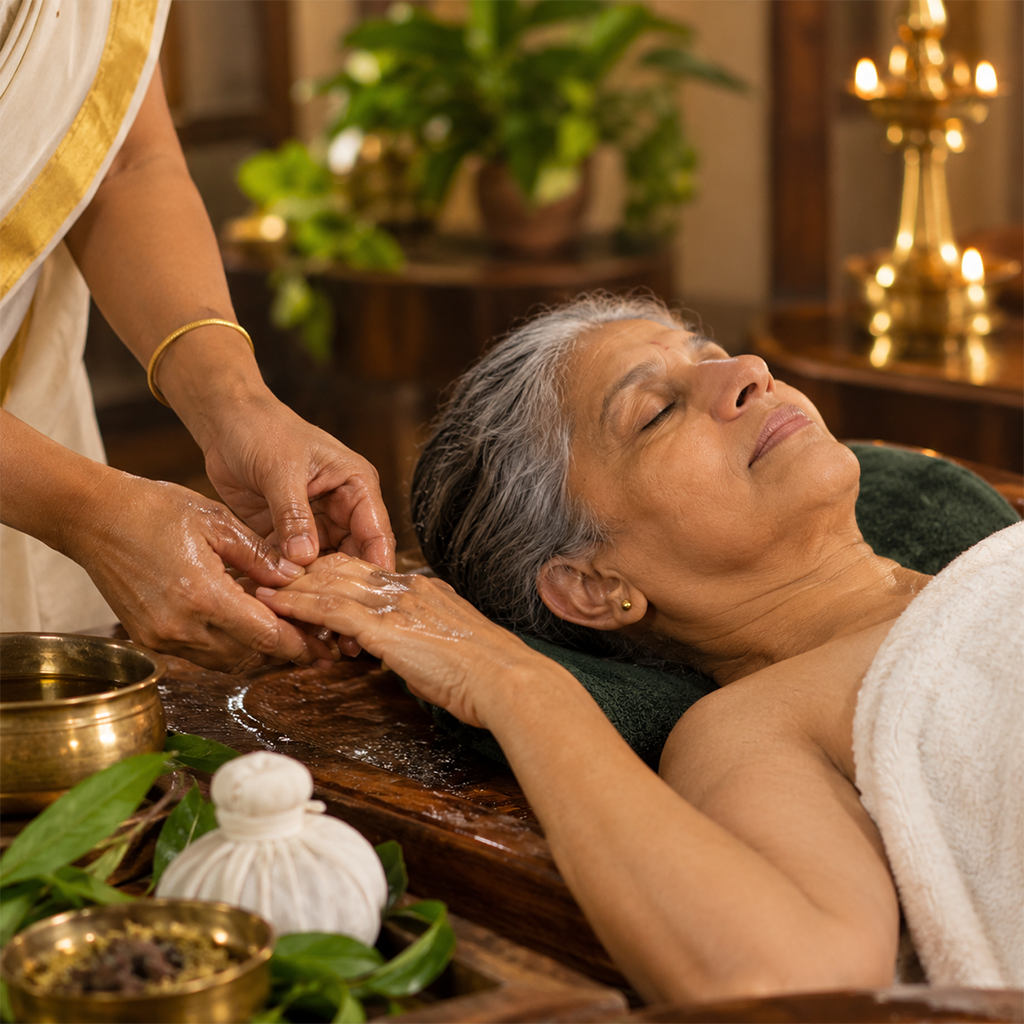
A 68-year-old woman with a history of arthritis came to Indimasi Healing Village for a 10-day Ayurvedic Panchakarma program. Her main concerns included mild pain in the finger joints and progressive finger deformity. She also wanted to improve the strength and function of her knees and shoulders. Alongside these joint concerns, she reported disturbed sleep and mild eye fatigue. She noted that her stress levels had already improved compared with an earlier period.
Her medical history included recurrent sinusitis and cataract surgery in both eyes. There was no reported recent trauma or injury. Her symptoms had developed gradually, and prolonged use of her hands and weight-bearing on her joints had become difficult.
On examination, she had swan-neck deformity of the fingers, a structural change associated with chronic joint disease. Such deformities reflect long-term changes and should not be expected to reverse through a short treatment program.
She was also a returning patient who visited our centre approximately every six months. Her regular visits reflected her preference for ongoing Ayurvedic care for a chronic condition, rather than seeking support only when symptoms became more troublesome.
Understanding the Diagnosis: Vata Rakta
The patient was discharged with an Ayurvedic diagnosis of Vata Rakta, a classical condition described in Ayurveda in relation to the interaction of Vata and Rakta, or blood tissue. In traditional Ayurvedic practice, this condition may be associated with joint pain, swelling, stiffness, and other musculoskeletal complaints.
This Ayurvedic classification should not be treated as a direct equivalent of a specific modern medical diagnosis. The patient’s chronic finger deformities and joint symptoms require interpretation within her overall clinical history.
Her disturbed sleep, eye fatigue, and history of recurrent sinusitis also informed the broader care plan. Rather than focusing exclusively on the fingers, our team planned a combination of internal Ayurvedic medicines, external therapies, digestive support, and daily mind-body practices.
For people exploring Ayurvedic treatment for Arthritic Joint Pain, understanding the individual’s symptoms, medical history, functional concerns, and treatment goals is important when planning care.
The 10-Day Ayurvedic Panchakarma Program
Our approach combined traditional Ayurvedic procedures with daily yoga and meditation. Treatment began with foundational digestive support and progressed through therapies selected for the patient’s joint concerns and other reported symptoms.
Preparatory Care: Digestion and Bowel Regularity
Treatment began with Deepana, traditionally used to support digestive fire, followed by Amapachanam, an Ayurvedic approach intended to address Ama within the traditional framework. Vatanulomanam was also used to support regular bowel movements and the downward movement of Vata as understood in Ayurveda.
These measures formed the initial stage of the program before and alongside the more targeted external therapies.
Day 1: Oil Massage and Knee Care
The first day included:
- Abhyangam: A traditional medicated oil massage.
- Steam therapy: Applied as part of the treatment schedule.
- Janu Pichu: Warm medicated oil retained over the knee joints.
Janu Pichu was included to address the patient’s interest in knee comfort and function.
Day 2: Broader Support for Relaxation and the Lower Limbs
The second day continued with Abhyangam and Janu Pichu, alongside additional therapies:
- Shirodhara: A traditional procedure involving a steady stream of liquid directed over the forehead.
- Medicated milk fumigation.
- Localized application of a warm herbal paste.
- Immersion of the legs in a warm fermented herbal liquid.
These procedures broadened the treatment plan beyond the affected joints, following the traditional approach selected for the patient.
Days 3–5: Joint-Focused Therapies and Nasal Care
During this phase, the program included:
- Abhyangam.
- Choorna Pinda Swedam: Massage using warm herbal powder poultices.
- Nasyam: Administration of medicated oil through the nasal route under practitioner supervision.
- Kabalam: A traditional medicated gargling procedure.
- Medicated herbal smoke inhalation.
- Continued Janu Pichu.
- Lepam: Application of an herbal paste to the affected joints.
An eye-focused treatment was also introduced toward the end of this phase because the patient had reported eye tiredness and had a history of cataract surgery.
Days 6–8: Herbal Poultices and Continued Supportive Therapies
The treatment plan then incorporated Jambeera Pinda Swedam, a warm poultice treatment using citrus and other herbal ingredients.
Janu Pichu and Lepam continued, alongside a deeper eye-focused therapy. Medicated inhalation and Kabalam were also continued during this phase.
Day 9: Medicated Rice Poultice Therapy
The ninth day included Abhyangam and Shashtika Pinda Swedam, a traditional procedure using a warm poultice prepared with medicated rice. Janu Pichu, medicated inhalation, and Kabalam were also continued.
Day 10: Final Day of the Program
On the final day, treatment included Tanusree, described in the treatment notes as a nourishing rice-and-herbal-decoction poultice, alongside continued Janu Pichu and Kabalam.
Throughout the admission, the patient also received internal Ayurvedic remedies intended to support joint health, digestion, and bowel regularity. She participated in 60 minutes of daily yoga and 30 minutes of meditation with Guru Yogi Shivan.
Guru Yogi Shivan’s Role in Daily Practice
Alongside the treatment schedule, Guru Yogi Shivan taught the patient a structured set of breathing exercises for regular practice at home.
The intended goals were to encourage relaxation, support breathing regulation, and contribute to overall well-being. The practices were also discussed in the context of managing discomfort and supporting respiratory well-being given her history of recurrent sinusitis.
Continued practice was encouraged as part of her daily routine. However, the available discharge notes do not establish that the breathing exercises reduced sinusitis recurrence or directly improved her joint symptoms.
Documented Outcomes at Discharge
The discharge information records changes in digestion, sleep, body weight, and blood pressure. It does not provide a specific outcome for every symptom that brought the patient to our centre.
Recorded changes
Body weight
64.7 kg → 62.4 kg
A recorded decrease of 2.3 kg during the 10-day admission. The notes do not establish the cause of this change.
Sleep
The notes report sound sleep by discharge, compared with disturbed sleep at presentation.
Digestion and bowel habits
Regular bowel movements, good appetite, and no reported gas or acidity by discharge.
Blood pressure
100/70 → 90/70 mmHg
Recorded at admission and discharge, respectively. The lower discharge reading should be interpreted clinically rather than automatically considered an improvement.
Outcomes That Need Confirmation Before Publication
The primary presenting concerns were finger joint pain, progressive deformity, and the desired improvement in knee and shoulder strength and function. However, the available notes do not specify the patient’s joint pain level, mobility, hand function, or eye tiredness at discharge.
These outcomes should be confirmed with the treating team before publication. Until then, we should not claim that the program reduced her joint pain, improved her knee or shoulder function, or relieved her eye symptoms. The documented weight change also should not be presented as proof of a specific treatment effect.
How the Treatment Plan Was Structured
The program followed a sequence that began with digestive support and bowel regularity before incorporating a range of external therapies. In Ayurvedic practice, Deepana, Amapachanam, and Vatanulomanam are used within a traditional framework that considers digestion and Vata regulation when planning care for certain chronic complaints.
The treatment schedule then combined full-body therapies, localized knee care, herbal poultices, and treatments addressing other reported concerns. Yoga and meditation formed part of the patient’s daily routine.
This was an individualized program rather than a single procedure used in isolation. Nevertheless, because several interventions were delivered together and the documented outcomes are limited, this case cannot identify which treatment, if any, caused a particular change. It also cannot establish that the program reversed structural joint damage or prevented future flare-ups.
For those considering Ayurvedic treatment for Arthritic Joint Pain, the practical takeaway is to discuss the intended goals, the available evidence, the risks of each procedure, and the plan for monitoring progress with qualified healthcare professionals.
Preventive Care for a Long-Standing Condition
The patient’s visits approximately every six months are an important part of her history. She returned to Indimasi Healing Village as part of an ongoing approach to managing her chronic concerns, rather than only seeking care during a severe flare-up.
Some people choose regular wellness visits to review symptoms, daily habits, and supportive care. However, there is no single schedule that is suitable for everyone, and the patient’s routine does not establish that six-monthly Panchakarma prevents disease progression.
Structural changes such as swan-neck finger deformity require appropriate medical assessment and ongoing management. Any complementary Ayurvedic program should be planned around the patient’s diagnosis, functional needs, other medical conditions, and current treatment.
What This Case May Mean for You
If you live with long-standing joint pain or stiffness, you may wonder whether a broader care plan can address concerns beyond the joints themselves. This case describes how one patient’s 10-day program combined traditional Ayurvedic procedures, internal medicines, yoga, and meditation while also considering her sleep, digestion, and other reported symptoms.
Our approach to Ayurvedic treatment for Arthritic Joint Pain should begin with a careful understanding of your health history and treatment goals. It should also include realistic expectations: this case documents better sleep and digestive symptoms at discharge, but does not provide confirmed outcomes for the patient’s joint pain, joint function, or eye fatigue.
At our wellness centre, treatment planning should be personalized rather than based on a promise of identical results. Anyone with persistent joint pain, progressive deformity, or reduced mobility should continue appropriate medical assessment and management.
Our Approach to Personalized Ayurvedic Care
At Indimasi Healing Village, our approach to care considers the person’s symptoms, health history, daily routine, and individual goals. Our work within Ayurveda draws on traditional practices, with treatment choices made according to the individual’s needs and the practitioner’s assessment.
For people exploring an Ayurvedic Healing Village or a Personalized Wellness centre in Kerala, it is important to understand the treatment plan, the expected outcomes, and the limits of what an individual case can demonstrate. We encourage informed discussions with qualified practitioners and coordination with the patient’s regular medical team where needed.
Our commitment to Authentic Healing in Kerala should go hand in hand with clear communication, responsible health claims, and realistic expectations. Any claim that Indimasi is NABH-Certified should be checked against current accreditation records and the exact scope covered before publication.
Medical Disclaimer
This case study describes one patient’s experience during a supervised 10-day Ayurvedic program at Indimasi Healing Village. The documented outcomes are limited to the information available in the case notes. The account does not establish that the treatment caused the reported changes or that similar outcomes can be expected by others.
Ayurvedic therapies are not a substitute for appropriate medical assessment, diagnosis, or treatment. People with chronic arthritis, progressive joint deformity, or other ongoing health concerns should continue care with their qualified healthcare professionals. Treatment decisions should account for individual risks, medical history, and existing medications.
Would you like to learn more about an individualized Ayurvedic care plan?
Enquire with our medical team to discuss your health history, concerns, and appropriate options.